
Asheboro Criminal History Checks
An Asheboro criminal history check should begin with the type and age of the record. Asheboro Police holds city reports. The Randolph County Sheriff's Office lists people now confined and keeps older county booking data. The North Carolina eCourts Portal holds public case summaries, while the Randolph Clerk supplies official copies and certified statewide searches. SBI offers a subject-only fingerprint Right to Review rather than a public name lookup.
- Ask Asheboro Police Records for the city crash or incident copy, using the incident number when known.
- For a recent confinement, browse the Randolph roster by date confined or last name and note the arrest agency and court reference.
- Search eCourts Smart Search by party name or the four-part Enterprise Justice case number.
- Verify filed charges, events, and disposition through the clerk when the Portal result is incomplete or an official copy is needed.
- Use the SBI fingerprint Right to Review only for your own North Carolina identification history.
These sources are connected, but none replaces the others. The city report explains the police event. The booking record shows custody. The court file controls the public case outcome.
Three Asheboro Record Addresses
Asheboro is a three-address justice system. Police records are at 205 East Academy Street. Court files are at the Randolph County Courthouse, 176 East Salisbury Street. Booking and current-custody records are at the Randolph County Detention Center, 811 New Century Drive. The offices are all in Asheboro, yet a request sent to the wrong building may not reach the custodian.
Asheboro Police Records
205 East Academy Street
Asheboro, NC 27203
336-626-1300, extensions 2106 or 2107
Weekdays, 8 a.m. to 5 p.m.
Randolph Clerk
176 East Salisbury Street, Suite 201
Asheboro, NC 27203
336-328-3100
Clerk counter, 8:30 a.m. to 5 p.m.
Detention Center
811 New Century Drive
Asheboro, NC 27205
336-318-6625
Current custody and booking questions
Use the Academy Street office for an APD report, Salisbury Street for a case file, and New Century Drive for custody. That simple split prevents most Asheboro request errors.
Records at the Asheboro Police Department
The Asheboro Police Department creates the city incident or arrest report. Its Records Unit works from the front lobby at 205 East Academy Street, Monday through Friday from 8 a.m. to 5 p.m. The main number is 336-626-1300, with Records at extensions 2106 and 2107. For a crash copy, provide the date, location, and driver's name. Those details can identify the event when the report number is missing.
The official APD department page shows the Asheboro police source below.
The Asheboro police source is the correct first stop for Asheboro report material, not for a court judgment or state rap sheet.
Chief Robbie Brown has served since March 2024 after joining the department in 1995. The department's annual report is the stronger source for current Asheboro operations. Individual Asheboro report access still runs through the Records Unit.
Asheboro Police Record Request Routes
APD provides an Asheboro Public Information Request form and several delivery paths. A request may be emailed to jkennedy@ci.asheboro.nc.us, dshropshire@ci.asheboro.nc.us, or jhanson@ci.asheboro.nc.us. It may be faxed to 336-625-3412, mailed, or delivered to APD, Attention Assistant Chief, at the Academy Street address. The official Asheboro form did not expose verified field labels during research, so state the record sought clearly instead of assuming unchecked requirements.
- Include the APD incident number when available.
- Give an approximate date, time, and Asheboro location.
- Name the document or public fields sought.
- Ask whether inspection is available before paying for copies.
- Request a cost estimate because no uniform city report fee was verified.
The Asheboro Police Support Operations page is the official Records Unit source shown below.
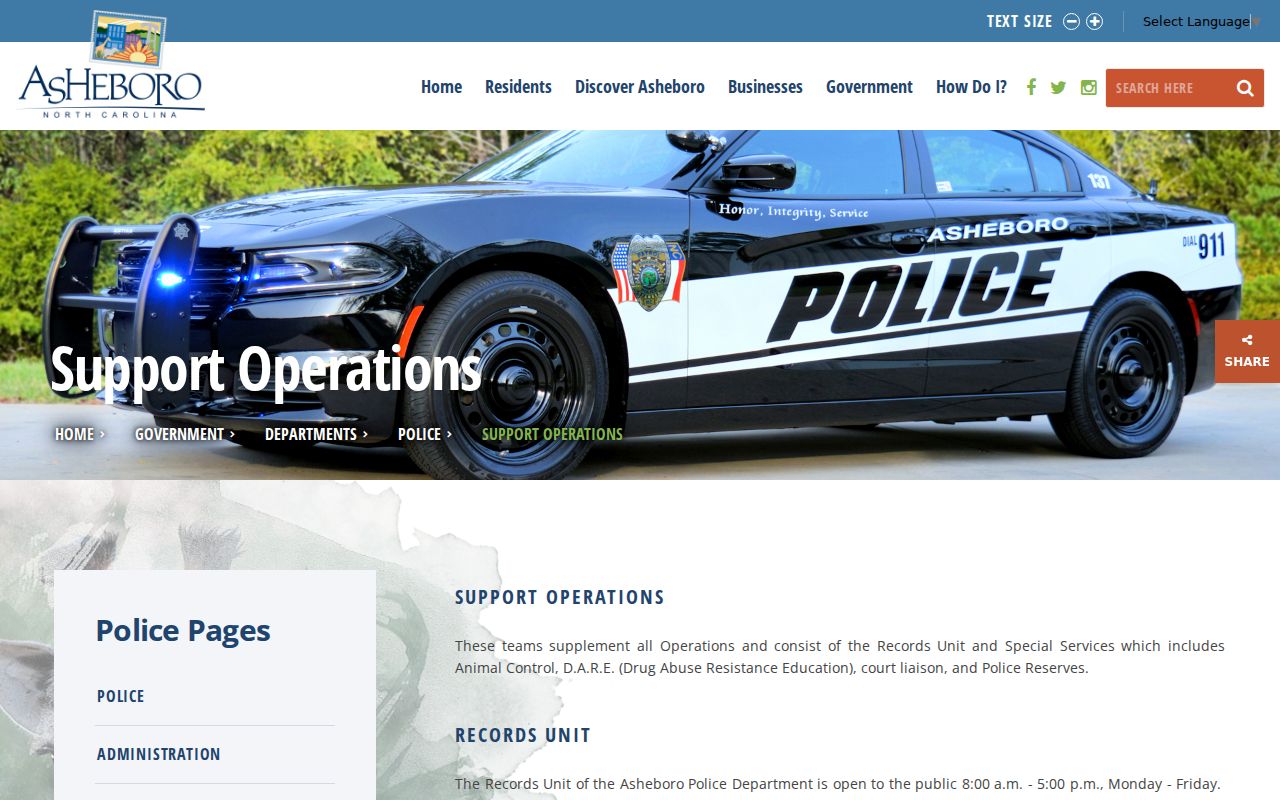
Keep a copy of the request and any incident number so later jail and court searches use the same Asheboro event.
Booking and Arrest Records in Asheboro
APD arrests do not stay only in a city file. The county's live roster has identified Asheboro Police as an arrest agency and the Randolph County Detention Center as the facility. A recent Asheboro confinement can therefore be traced without treating APD as the jail. Browse the county's Date Confined list for recent intake or the Last Name list for an alphabetical view. Expand a row to see public booking facts.
The roster may display incarceration and arrest times, arrest type, agency, officer, location, offense text, incident and court references, bail, facility, and pod classification. It refreshes four times each day. It is not a complete Asheboro arrest archive, and its own notice says a booking entry does not establish criminal status, criminal history, or a case result. Once a person is released, use a focused sheriff records request and the court file.
Note: The county roster covers present custody and can lag after bond or release, so confirm time-sensitive facts with the detention line.
Searching Asheboro Arrests by Date
For a recent Asheboro event, start with the Date Confined report rather than a broad name scan. Find the likely intake date, expand the matching row, and record only the identifiers needed to verify the event. The arrest agency field matters because it directs the next report request. If it says Asheboro Police, APD owns the Asheboro city report even though the sheriff maintains the jail entry.
Useful sequence: Date Confined report › arrest agency and incident number › APD report request › court reference in eCourts.
The incident number and court reference are not interchangeable. Randolph Enterprise Justice case references commonly end in -750, while a police incident uses the agency's own format. A missing eCourts result shortly after arrest may reflect filing time or a number mismatch rather than proof that no event occurred.
The Asheboro Municipal Court File
Asheboro has no municipal criminal court. North Carolina replaced local courts with its unified General Court of Justice during the 1966 to 1970 rollout. A city citation or APD charge goes into state District Court or Superior Court in Randolph County. District Court hears misdemeanors and infractions and handles preliminary felony steps. Superior Court tries felonies.
| Court name | Randolph County District Court or Superior Court |
|---|---|
| Municipal court | None; Asheboro keeps no separate city criminal docket |
| Lookup channel | North Carolina eCourts Portal, clerk terminal, or clerk paper file |
| Public case fields | Case number, division, parties, charges, events, hearings, disposition, judgment, and sentence when available |
| Official copies | Randolph Clerk of Superior Court, 336-328-3100 |
The free Portal supplies informational summaries. A clerk search costs $25 when a certified statewide North Carolina court-record check is requested with form AOC-CR-314. Ordinary case-copy costs depend on the copy sought and should be confirmed with the clerk.
Asheboro Court Record Device Rule
The Randolph County Courthouse bars cell phones, computers, multimedia devices, and cameras. This is a practical Asheboro records issue because a visitor cannot count on showing a case number from a phone or photographing terminal results. Bring names and case references on paper. Be ready to order a paper copy from the clerk if information must leave the building.
The courthouse operates Monday through Friday from 8 a.m. to 5 p.m.; the clerk counter is listed from 8:30 a.m. to 5 p.m. Public terminals and paper files are the authoritative local channels. The courthouse main number is 336-328-3000, and the clerk line is 336-328-3100. The restriction makes advance preparation more useful than an extra online search.
How Asheboro Records Reach the County
An APD officer creates the city incident or arrest report. If confinement follows, Randolph detention staff create a separate booking record and collect intake identifiers. A judicial official handles the first appearance and release conditions. Prosecutors decide how allegations are filed, and the clerk records the case events and disposition. Qualifying fingerprint and disposition data later reach the SBI.
Record flow: Asheboro Police Department › Randolph County Courts › North Carolina State Bureau of Investigation
That flow explains why initial APD charge text can differ from the final court result. A prosecutor may amend or decline a charge, and a court may dismiss or resolve it under different wording. Use the Randolph County Court Case Lookup for the filed outcome rather than reading a booking line as the last word.
Asheboro as a Records Hub
Asheboro is Randolph County's largest wholly contained city and its county seat. OSBM estimated 28,051 residents in July 2024, while Census QuickFacts estimated 27,928. City police, county court, sheriff headquarters, detention, and fingerprint channels are concentrated here, but they do not form one database. The city is also known for the North Carolina Zoo and its 2016 All-America City designation.
The City of Asheboro homepage supplies the official Asheboro view below.

Physical closeness makes Asheboro access practical, while custody rules still require each record to be requested from the office that created it.
Reading Asheboro Crime Record Counts
FBI Crime Data Explorer figures for APD's ORI NC0760100 report 105 violent and 686 property offenses known in 2024. These are agency-reported offenses, not convictions, custody totals, or a prediction about a person. They should not be compared with the jail roster as if the two systems count the same thing. A reported offense may have no arrest, and one event may involve several records.
Use the annual figure for broad Asheboro operational context. Use an incident number for a police report, a booking row for current custody, and a case number for the court outcome. Keeping those units distinct is a core part of an accurate Asheboro record check.
Asheboro Record Access Rules
North Carolina Public Records Law governs Asheboro city records, but it does not open every police narrative. G.S. 132-1.4 generally protects criminal investigation and intelligence material while requiring listed basic arrest and incident information. G.S. 7A-109 makes court records and indexes open unless another law or court order restricts them. Juvenile files, protected victim details, medical data, sealed filings, and expunged records can remain unavailable or be redacted.
Key statutes:
North Carolina Public Records Law, Chapter 132 provides inspection and copy rights subject to exemptions, including the limits in G.S. 132-1.4.
G.S. 7A-109 opens court records and indexes unless law or court order says otherwise.
G.S. 15A-151 restricts disclosure of expunged material.
Ask APD for segregable public fields when a full narrative is withheld. Court documents belong to the clerk, and state identification histories belong to SBI. Matching the request to the Asheboro custodian is as important as matching the name.