
High Point Criminal History Checks
A High Point criminal record does not sit in one city file. The High Point Police Department keeps its incident, accident, arrest, and citation records. A detention center keeps a separate booking record. The North Carolina General Court of Justice keeps the criminal case. The SBI receives qualifying fingerprint-supported arrest and disposition data, but it does not offer a public name-search portal. Start with the record that answers the question, then use its number to move to the next custodian.
- Confirm the street address and county for the High Point event. Do not infer the county from the city name.
- Search HPPD Police-to-Citizen for city police activity, or ask Police Information for the report-copy channel.
- If there was confinement, check the detention roster for the county where the High Point arrest occurred.
- Search North Carolina eCourts by party name or case number, with the correct county location filter.
- Ask the filing county clerk for an official copy or certified statewide court-record search when certification is needed.
For Randolph-side cases, the broader Randolph County Court Case Lookup explains clerk copies, public terminals, and eCourts fields in more depth.
High Point Record County Check
High Point is the only North Carolina city spread across four counties: Guilford, Davidson, Forsyth, and Randolph. That is the key local trap. An HPPD badge or a High Point mailing address does not prove which jail accepted a person or which clerk holds the case. Most city activity is outside Randolph County, yet Randolph-side events still use the same city police department. The event site and court location control the next step.
County check: Match the incident location to its county before searching a jail roster or court file. Search more than one county only when the location remains uncertain.
A High Point record tied to Randolph County may appear in the Randolph confined-inmate list and Randolph eCourts results. An event across the line will not move into Randolph merely because the police report says High Point. This first check saves false matches and missed files.
Records at the High Point Police Department
The High Point Police report-access page directs readers to report copies and the city P2C service. High Point Police Department headquarters is at 1730 Westchester Drive, High Point, NC 27262. The nonemergency number is 336-883-3224. Police Information is available around the clock at 336-887-7940. HPPD says accident and incident copies ordinarily become available within 48 to 72 hours, so a same-day miss may reflect processing rather than the absence of a report.
The official High Point report page is shown below as a visual reference.
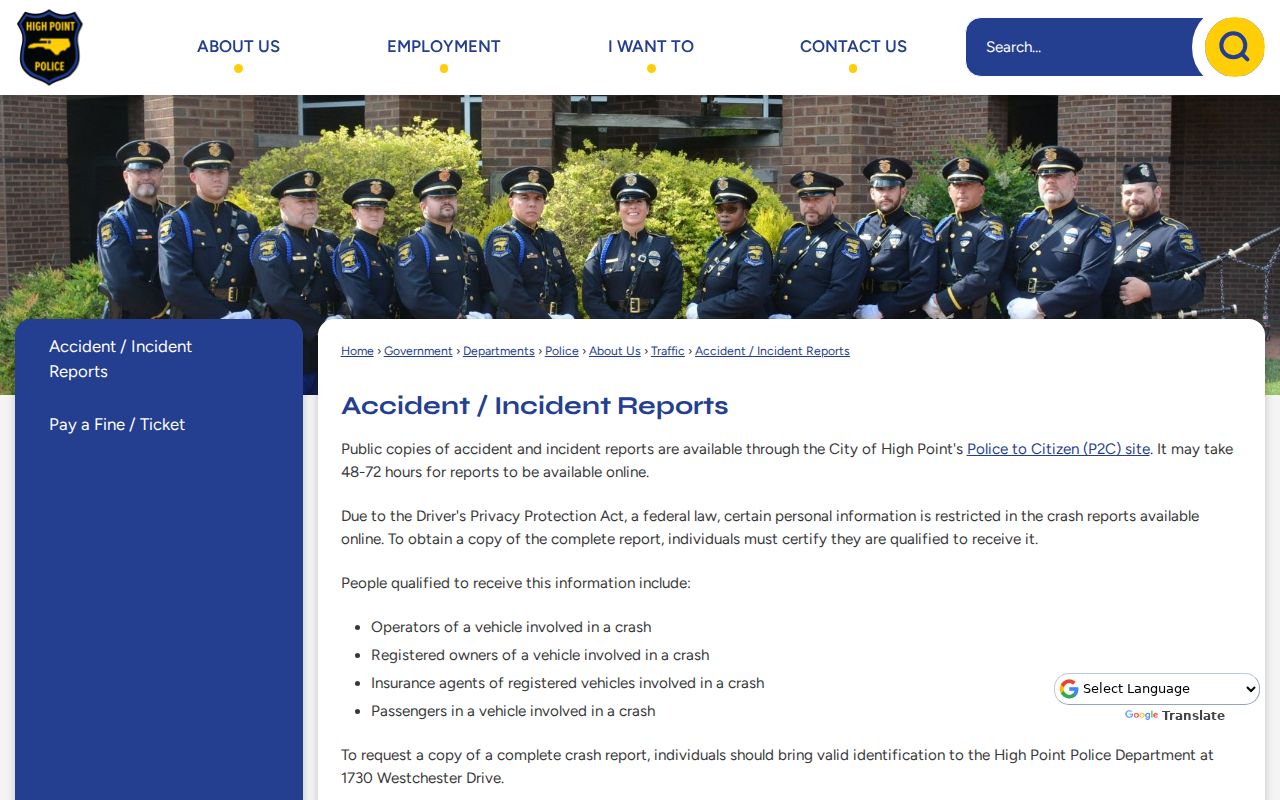
Use the report or event number from this High Point channel to connect police facts with a later booking or court case.
Online crash copies redact personal data covered by the Driver's Privacy Protection Act. A qualifying operator, registered owner, insurer, or passenger may seek a complete version at headquarters with valid identification. That distinction matters when a public copy looks sparse.
Searching High Point P2C Records
The official High Point Police-to-Citizen portal is a city police database, not a statewide criminal-history search. Its modules support accident and incident access, daily arrests and citations, reported-incident exploration, mapping, and daily bulletin functions. Depending on the module, useful controls include a report or event number, date range, incident or location, person name, and event type.
| High Point P2C control | Best use | Limit |
|---|---|---|
| Report or event number | Locate one known police event | Not a court case number |
| Date range | Narrow daily activity | Processing may take 48 to 72 hours |
| Incident or location | Distinguish similar events | Confirm the county separately |
| Person name | Find a listed police event | A match is not a conviction |
| Event type | Filter the module | Options vary by module |
The live High Point P2C interface appears below.
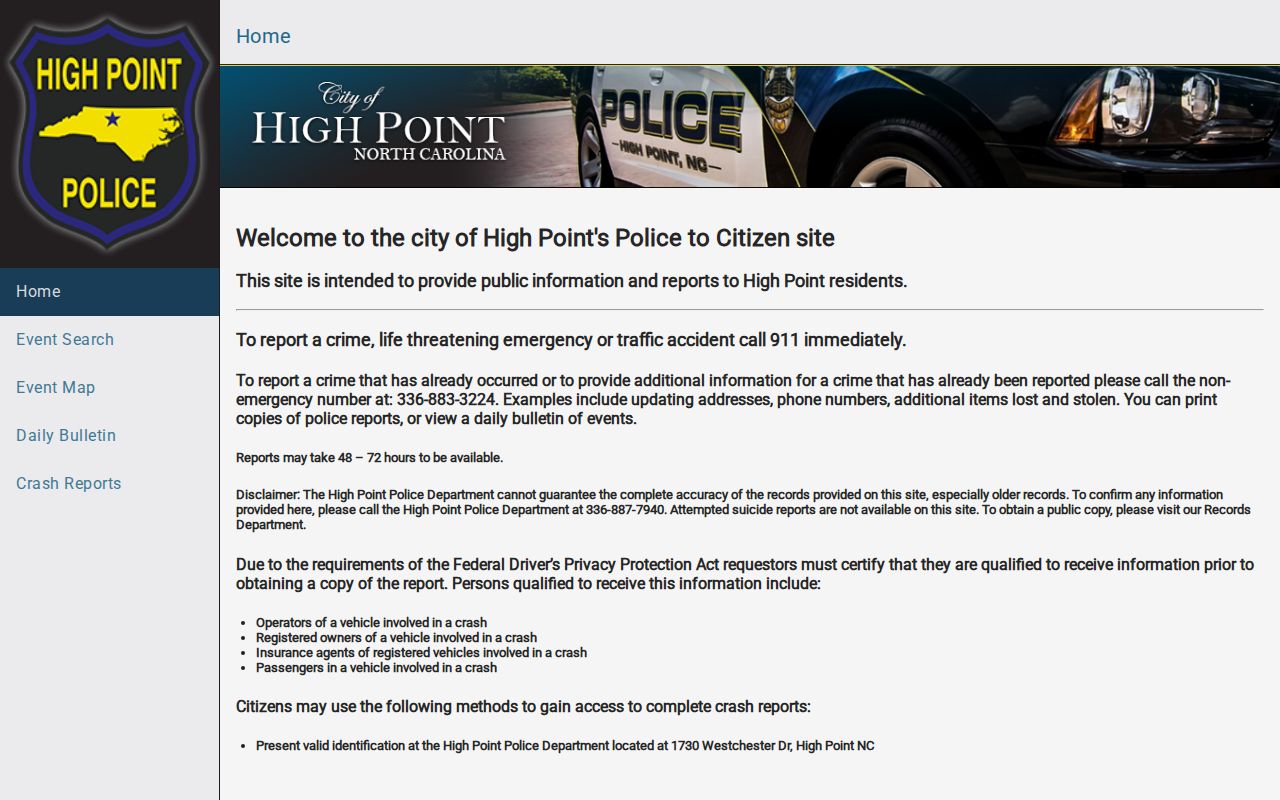
P2C supplies the city layer. If the event became a Randolph County case, carry its reference into eCourts rather than treating the police entry as the final outcome.
Booking and Arrest Records in High Point
A High Point arrest creates more than one record. HPPD owns the police arrest or incident report. The receiving jail owns intake, bail, and current-custody data. A judicial official sets early release conditions, and the filing clerk maintains the case after charges reach court. The arrest wording can later be changed, declined, dismissed, or resolved under a different charge.
For a Randolph-side High Point arrest, search the Randolph County confined-inmate reports by date confined or last name. That roster refreshes four times per day and covers current custody, not a full High Point arrest archive. The county list may show arrest time, agency, location, related incident, court reference, charge text, and bail. After release, ask the arresting agency for its report and use eCourts or the clerk for the case. Full county booking channels are covered in the Randolph County Arrest Search.
Note: A High Point arrest or citation is an allegation and activity record, not proof of guilt or a final disposition.
High Point Online Police Reports
HPPD accepts certain nonemergency online reports when the event occurred inside city limits, the filer is at least 18, and a valid return email is supplied. Eligible categories include threats, fraud, harassment, identity theft, lost property, neighborhood disputes, certain shoplifting, vehicle break-ins, theft, traffic complaints, trespass, vandalism, littering, and supplemental reports. Emergencies and active events do not belong in that workflow.
A submission first receives a temporary number and an emailed copy. An eligible, correct report normally receives approval and a permanent number within 72 hours. Staff may ask for more facts, refer the event to an investigator, or reject a report that does not meet the online rules. Keep both numbers until approval, since the temporary identifier does not yet represent the permanent High Point police record.
- Temporary number
- The tracking reference issued when an online High Point report is submitted.
- Permanent number
- The report identifier assigned after police staff review and approve the submission.
- Supplemental report
- Added facts linked to an existing High Point police event rather than a new incident.
The High Point Municipal Court File
There is no High Point municipal criminal court. North Carolina abolished local municipal courts as the unified District Court system was phased in from 1966 through 1970. A city citation does not produce a city-court docket. It goes to the state General Court of Justice in the county where the case was filed. District Court handles misdemeanors, infractions, and preliminary felony matters. Superior Court tries felonies.
| Court name | North Carolina District Court or Superior Court in the county of filing |
|---|---|
| High Point court? | No municipal criminal court or standalone city criminal docket |
| Case lookup | North Carolina eCourts Portal, clerk terminal, or paper file |
| What it shows | Parties, filed charges, events, hearings, disposition, judgment, and sentence when public |
| Official copies | Requested from the clerk in the county where the case was filed |
For Randolph-side High Point records, newer Enterprise Justice case references commonly carry Randolph's three-digit county identifier, -750. Verify the location field as well as the suffix before relying on the match.
Anonymous High Point Record Requests
High Point's public-record request process does not require a written request, a requester name, or a reason. An anonymous requester should save the tracking reference. Electronic copies are free. A CD, DVD, or USB copy is $5; black-and-white pages cost $0.07 each and color pages cost $0.10 each. These city fees concern public-record copies, not certified criminal court searches.
The official High Point public-record request page is shown below.
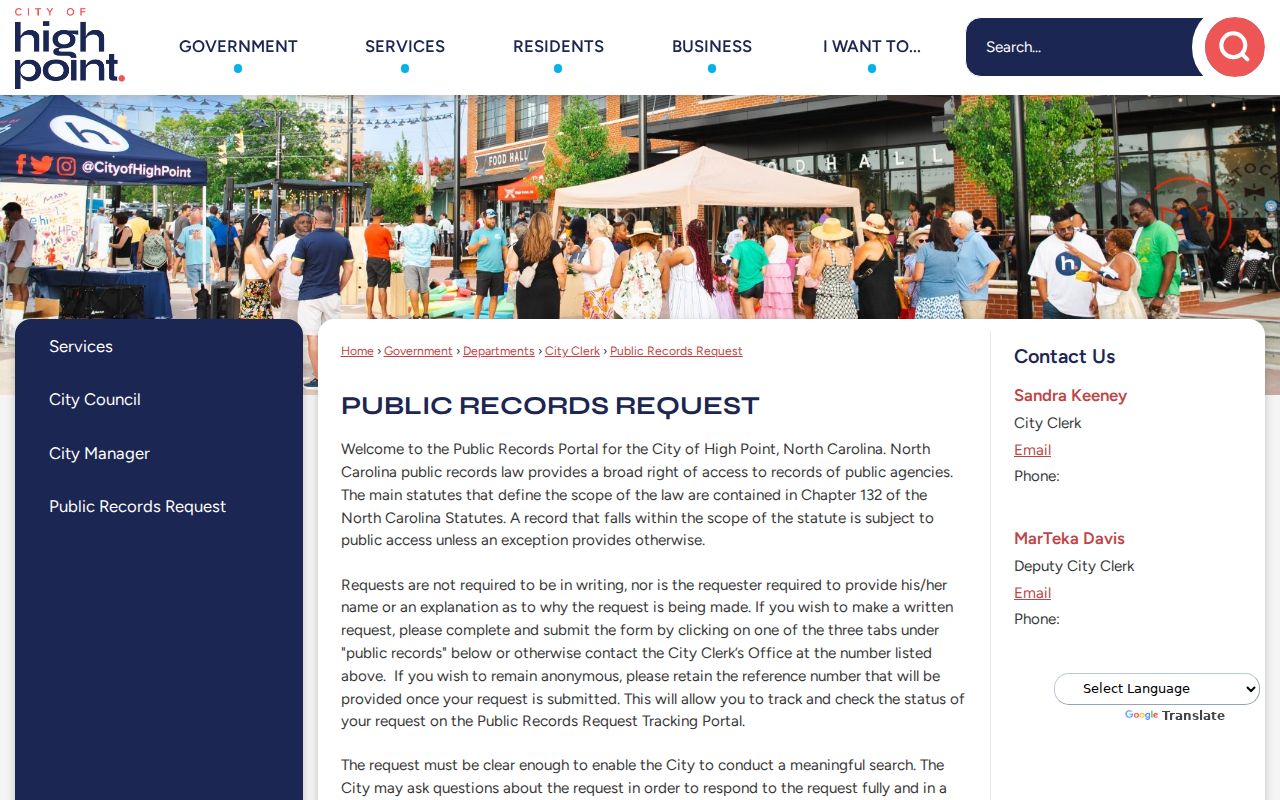
The High Point tracking reference is especially useful for an anonymous request because staff do not have a requester name to reconnect the file.
For 911 material, provide an Event ID or report or run number when possible. Otherwise give the date, time, caller telephone, and street address; the business name, cross streets, and event nature may help. High Point says audio is purged after 90 days. Voices, names, addresses, or phone numbers may be altered or redacted. The administrative specialist number is 336-887-8492.
How High Point Records Reach the County
For a Randolph-side event, HPPD creates the city incident or arrest report. Jail staff create a distinct booking file if the person enters Randolph County custody. The District Attorney and clerk handle filed charges and court events. Qualifying fingerprint-supported arrest and disposition data can move into SBI systems. Each custodian records a different stage, so wording and dates may not match line for line.
Record flow: High Point Police Department › correct county jail and courts › North Carolina State Bureau of Investigation
A very recent High Point event may appear first in P2C. A jail entry answers current-custody questions. eCourts shows the public case chronology once filed, while the clerk supplies official copies. SBI Right to Review is the subject-only route for a fingerprint-supported North Carolina identification history.
Reading High Point Crime Records
FBI Crime Data Explorer figures for HPPD's ORI NC0410300 report 545 violent and 2,941 property offenses known in 2024. Those are whole-department figures across High Point, not Randolph-only counts. They are also offense reports, not arrests, charges, convictions, or a forecast about a person or neighborhood. The county-line issue makes that distinction vital.
Use aggregate High Point figures for broad city context only. Use a report number for one police event, a court number for one filed case, and the correct detention roster for one custody check. Mixing those levels can turn a citywide total into an unsupported claim about a Randolph-side record.
High Point Police Record Milestones
High Point was chartered in 1859 near the railroad and plank-road high point, then grew through furniture, textiles, and the High Point Market. HPPD also dates to 1859. Its official history notes Black officers serving in 1943, body cameras arriving in 2020, and the Westchester headquarters opening in 2021. Chief Curtis Cheeks III became the department's first Black chief in 2024.
The official HPPD profile provides the source view shown below.

That long High Point records history now includes body-camera material and the LINK High Point Real Time Crime Center program, which permits voluntary camera registration or integration.
High Point Record Access Rules
High Point police records and North Carolina court records follow different access laws. Chapter 132 generally calls for inspection and copies of public records, yet G.S. 132-1.4 keeps criminal investigation and intelligence records nonpublic while requiring listed basic arrest and incident facts. Court indexes and records are open under G.S. 7A-109 unless another law or a court order restricts access. Juvenile files, protected victim details, sealed material, and expunged records may be withheld or redacted.
Key statutes:
North Carolina Public Records Law, Chapter 132 requires reasonable access to public records while G.S. 132-1.4 limits investigative files.
G.S. 7A-109 governs public inspection of court records and indexes.
G.S. 15A-151 limits disclosure of expunged records.
Ask HPPD for segregable public fields if a narrative cannot be released. Ask the correct county clerk for court papers. The source, location, and record stage remain the best checks against a false High Point match.